Lucknow: Doctors at Medanta Lucknow successfully performed a PDA stenting procedure on a three-day-old newborn suffering from a complex congenital heart defect, helping restore blood flow to the lungs without open-heart surgery.
The 4-kg baby had a large ventricular septal defect (VSD), or a hole between the heart’s lower chambers, along with pulmonary atresia, a condition in which the main artery carrying blood from the heart to the lungs is not properly developed. In such cases, blood reaches the lungs through the patent ductus arteriosus (PDA), a blood vessel that normally closes naturally within a few days after birth.

In this case, the PDA began closing on the third day, causing the newborn to turn blue and his oxygen saturation to fall to a critical 50 per cent. Doctors determined that keeping the PDA open was essential to maintain blood flow to the lungs and decided to perform PDA stenting.
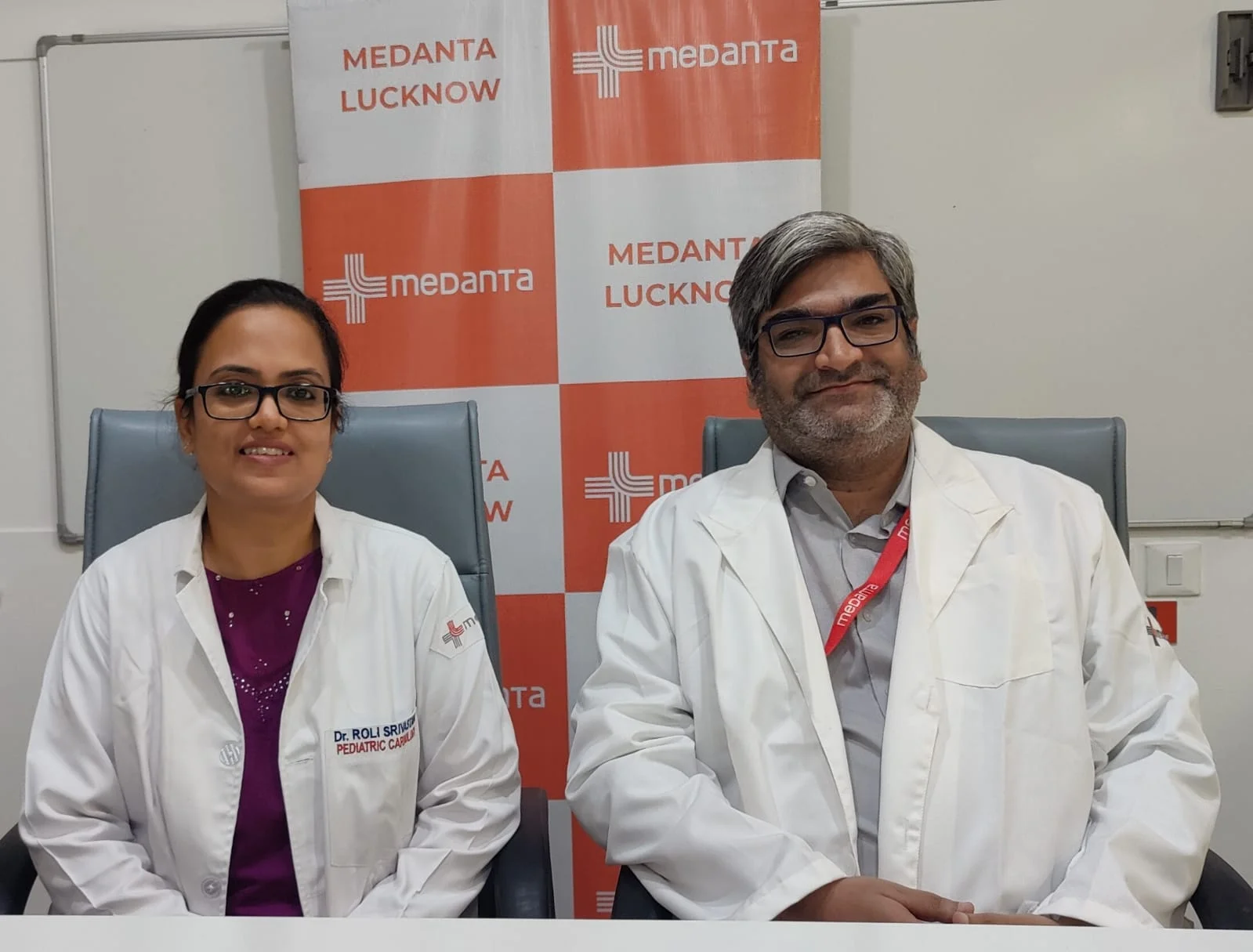
The procedure was carried out by Dr. Mahim Saran, Director, Interventional Cardiology, Medanta Lucknow, and Dr. Roli Srivastava, Senior Consultant, Pediatric Cardiology.
Investigations showed that the baby’s PDA was long, vertical and tortuous, making the procedure technically challenging. To minimise the newborn’s exposure to the cold catheterisation laboratory environment, femoral access was obtained in the NICU itself with ultrasound guidance. A second vascular route was also used during the procedure to advance the stent into the PDA and confirm its correct positioning.

A small stent was successfully placed inside the PDA to keep the vessel open and maintain pulmonary blood flow. Immediately after the procedure, the baby’s oxygen saturation improved from 50 per cent to 85 per cent, indicating better blood flow to the lungs.
Dr. Mahim Saran said that maintaining PDA patency is crucial in children with such congenital heart conditions because the vessel serves as an important route for blood to reach the lungs. Premature closure can lead to rapid deterioration, making timely intervention critical.
Dr. Roli Srivastava said PDA stenting can help selected children avoid major procedures such as open-heart surgery and a Blalock-Taussig (BT) shunt. However, the treatment can have challenges, including clot formation within the stent and the possibility of requiring another procedure in the future. Hospitalisation may nevertheless be shorter than with open surgery in suitable cases.